The word “butt” in archery doesn’t mean what most people assume. It comes from the Old French “but,” meaning target or goal, and it’s been part of archery vocabulary since at least the 13th century.
If you’ve ever walked through an English village and noticed a street called “The Butts” or a field marked “Butt Close,” you’ve stumbled onto a piece of medieval archery infrastructure hiding in plain sight.
For centuries, archery butts were the training grounds where ordinary Englishmen were required by law to practice their shooting. These weren’t optional hobby spaces.
They were a matter of national defense, and the skills honed on those earthen mounds helped win some of the most decisive battles in European history. If you’re still getting familiar with the terminology, our archery terms glossary covers the full vocabulary.
The story of archery butts stretches from medieval village greens to modern Olympic venues. Some of history’s most famous archers got their start on fields just like these, and understanding how these practice grounds worked gives you real insight into how archery evolved from a survival skill into a precision sport.
What Are Archery Butts?
An archery butt, in its original form, was an earthen mound typically 6 to 8 feet wide and 4 to 5 feet high, packed with turf or soil and used as a backstop for arrows. The mound caught stray shots and made arrow retrieval straightforward, which mattered when arrows were expensive to produce.
The word “butt” referred both to the mound itself and, over time, to the entire practice field where mounds were set up. This dual meaning still causes confusion today.
Medieval archers distinguished between two types of practice. “Butts” meant close-range shooting at point-blank distance, where you aimed directly at the target without accounting for arrow drop.
“Marks” referred to long-distance shooting at stakes set in the ground, where archers had to judge elevation and wind.
This distinction mattered because battlefield archery required both skills. You needed point-blank accuracy for close engagements and the ability to loft volleys of arrows over hundreds of yards onto advancing formations.
History Of Archery Butts
The legal history of archery butts in England starts with the Assize of Arms in 1252, which required every man between 15 and 60 to own a bow and arrows appropriate to his station. This wasn’t a gentle suggestion.
Local sheriffs enforced compliance, and failure to own the proper equipment could result in fines.
In 1363, Edward III went further by mandating that all able-bodied men practice archery on Sundays and holidays. Other sports were actually banned to prevent men from wasting time on anything besides bow training.
Football, handball, cockfighting, and other pastimes were specifically outlawed because they distracted from archery practice.
The problem with mandatory archery was stray arrows. Untrained men loosing shafts in village centers caused injuries and property damage, so local authorities designated specific parcels of land outside settlements for butt construction.
These fields were carefully positioned so that arrows flew away from roads, homes, and livestock.
Henry V, who relied heavily on archers at Agincourt in 1415, took the national archery obsession to industrial scale. He reportedly stored 500,000 arrows in the Tower of London in preparation for his French campaigns.
That kind of stockpile required thousands of trained bowmen, and those bowmen learned their craft on village butts across England.
The legacy of these practice fields is embedded in English geography. Towns from London to Yorkshire still have areas named “The Butts,” “Butt Lane,” or “Butt Close,” marking where medieval archers once trained every Sunday afternoon.
Transformation Of Archery Butts
The earliest archery practice didn’t involve purpose-built targets at all. Hunters simply shot at tree stumps, animal hides, or mounds of packed earth.
The formalization of butts as structured training spaces came with organized military archery, particularly in medieval Europe.
But the roots of archery itself go back far deeper. The Sibudu Cave in South Africa holds arrowhead fragments dating to roughly 64,000 years ago, making them the oldest evidence of bow-and-arrow technology ever discovered.
These weren’t crude stone chips. Analysis shows they were carefully shaped and attached to shafts with plant-based adhesive.
In Turkana County, Kenya, archaeologists found arrow fragments lodged in human skeletal remains, including a thoracic cavity and a skull. This is direct evidence that people were shooting arrows at each other in prehistoric East Africa, long before any formal training ground existed.
Europe’s earliest archery evidence comes from the Ahrensburg valley near Hamburg, Germany, where pine arrow shafts dating to roughly 10,000 BC were recovered. These artifacts suggest that archery was already well established among European hunter-gatherers by the end of the last Ice Age.
As archery moved from hunting tool to military weapon, the need for structured practice spaces grew. Egyptian and Mesopotamian armies trained archers to shoot from chariots and on foot, which required flat, open ground with defined targets.
The Chinese took things a step further by developing gunpowder-boosted arrows, essentially early rockets, which demanded entirely new training methods and safety considerations.
The transition from packed-earth mounds to straw-filled targets happened gradually over centuries. By the late medieval period, butts often featured woven straw faces pinned to the earthen mound, giving archers a more visible aiming point and making scoring easier.
Archery Butts & Development In Technology
When firearms rendered military archery obsolete, the bow didn’t disappear. It reinvented itself as a sport.
The key moment came in 1844, when the Grand National Archery Society held its first meeting in York, establishing formal competition rules that would shape the sport for the next century.
The dominant figure of this era was Horace A. Ford, who won the Grand National championship 11 consecutive times between 1849 and 1859.
Ford wasn’t just a talented shooter. He was an analytical thinker who studied form, technique, and equipment in ways nobody had before.
His 1856 book, “Archery: Its Theory and Practice,” became the first serious technical manual for the sport and influenced generations of archers.
Despite Ford’s efforts, archery struggled against newer leisure activities. Tennis and croquet exploded in popularity among the Victorian middle class during the 1870s and 1880s.
By 1889, the number of active archery clubs in Britain had dropped to roughly 50, down from hundreds just decades earlier.
Archery fared better in Asia. Emperor Gojong of Korea championed archery as both a cultural tradition and a competitive discipline during the late 19th century.
In Japan, Kyudo (the Way of the Bow) preserved traditional archery as a meditative and spiritual practice, deliberately resisting modernization. Japanese archers still use asymmetric bamboo longbows that would look familiar to a 15th-century samurai.
Modern target technology has transformed the butts themselves. Self-healing foam targets can absorb thousands of arrows before replacement.
Layered polyethylene targets stop arrows cleanly without damaging shafts. Electronic scoring systems can detect arrow placement to within a millimeter, eliminating the human judgment calls that once decided competitions.
Description Of Archery Butts
The classic archery target that most people recognize is a round face with concentric colored rings: gold in the center, then red, blue, black, and white moving outward. This design was standardized in the 19th century and hasn’t changed much since.
Standard outdoor target faces come in two sizes. The 122-centimeter face is used for longer distances (60 to 90 meters), while the 80-centimeter face is used at shorter ranges (30 to 50 meters).
Indoor faces are smaller still, typically 40 centimeters, because the shooting distances are much shorter.
Modern 3D archery has introduced an entirely different kind of target. These are life-sized foam animal replicas, complete with anatomically correct scoring zones marked on the vital areas.
You’ll find foam deer, elk, bears, turkeys, and even African game animals on 3D courses, each positioned at unmarked distances to simulate real hunting scenarios.
The materials behind modern targets have come a long way from packed earth and straw. Competition targets use layered foam or compressed straw bales that stop arrows efficiently without excessive wear on shafts or points.
High-end self-healing foam targets can take tens of thousands of shots before they need replacement. Budget-friendly options still use tightly compressed straw or hay bales, which work surprisingly well for backyard practice.
How Were Archery Butts Used?
Modern competitive archery operates under rules set by the World Archery Federation, which governs everything from target dimensions to shooting time limits. The sport has been part of the Olympic Games since 1900, was dropped after 1920, and returned permanently in 1972.
Indoor and outdoor archery use different distances and target sizes. Indoor competitions typically shoot at 18 meters (though some events use 25 meters), with smaller target faces that demand precision at relatively close range.
Outdoor target archery stretches the distance to 70 meters for Olympic rounds, though other formats use distances from 30 to 90 meters.
Target archery is the most widely practiced format, where archers shoot a set number of arrows at stationary targets from fixed positions.
It traces its roots directly to the medieval butt fields, just with better equipment and standardized rules.
The core principle hasn’t changed in 700 years: stand at a marked distance and put your arrows as close to the center as possible.
Field archery takes the sport into the woods. Targets are set at varying distances along a walking course, often on uneven terrain with uphill and downhill shots.
This format became popular in Europe and North America as a way to simulate hunting conditions while keeping the structure of competitive scoring. 3D archery is a variation of field archery that replaces flat target faces with those life-sized foam animals, testing your ability to judge distance and pick the right aiming point on an irregular shape.
Setting Up Archery Butts
Modern target faces use concentric scoring rings numbered 1 through 10, with 10 at the center. The innermost ring, smaller than the 10, is marked X.
In outdoor competition, the X-ring serves as a tiebreaker. If two archers finish with identical scores, the one with more X-ring hits wins.
Indoor archery treats the X-ring slightly differently. It still counts as 10 points, but it’s recorded separately on the scorecard for tiebreaking purposes.
Some indoor formats use a three-spot target face, where archers shoot one arrow at each of three smaller target faces instead of clustering all arrows on a single face.
For practical setup, the target butt needs to be mounted at the correct height with the center (the gold) at approximately 130 centimeters from the ground. The backstop behind the target should extend well beyond the target face on all sides.
A clear safety zone of at least 50 meters behind the target line is standard for outdoor ranges, and side netting or barriers prevent lateral strays.
Scoring follows a simple rule: an arrow that touches a line between two scoring zones gets the higher value. This “line-cutter” rule applies at all levels of competition and is one reason why precision in arrow placement matters down to the millimeter.
Advantages Of Archery Butts
Structured target practice on butts gives archers something that instinctive shooting can’t: measurable feedback. Every arrow leaves a hole in the target, and over dozens of ends, patterns emerge that reveal flaws in your form, your release, or your equipment tuning.
You can’t improve what you can’t measure, and butts provide the measurement.
Dedicated butt fields also create a controlled safety environment. Arrows fly in one direction into a known backstop, and the range layout keeps spectators and other archers out of the line of fire.
This was the entire reason medieval villages built designated butt fields in the first place, and it remains the primary advantage of any properly set up range.
The competitive structure built around target butts gives archers a clear progression path. You can track your average scores over weeks and months, set specific goals (like consistently hitting the gold at 40 meters), and compare your performance against classification standards.
World Archery publishes score thresholds for different skill levels, so you always know where you stand relative to national and international benchmarks.
For coaches and instructors, butts are essential teaching tools. They can diagnose a student’s grouping patterns and make targeted corrections.
An archer who consistently hits low-left, for example, likely has a grip issue or is collapsing on release. Without a target face to reveal that pattern, diagnosing the problem would take much longer.
Limitations Of Archery Butts
Space is the biggest practical barrier. A proper outdoor archery range needs at least 120 meters of clear, flat ground when you account for shooting distances and safety overshoot zones.
Most urban and suburban archers simply don’t have access to that kind of space, which is why indoor ranges with shorter distances have become so popular.
Weather dependency limits outdoor butt practice for much of the year in many climates. Wind doesn’t just make shooting harder.
It physically moves arrows off course, which means scores on a gusty day don’t reflect your actual skill level. Rain degrades straw targets quickly and makes foam targets slippery for arrow removal.
Maintenance is an ongoing cost that many archers underestimate. Straw targets need replacing every few months under heavy use.
Foam targets develop worn centers where arrows cluster, eventually failing to stop shafts at all. Even the ground around the target line gets chewed up from foot traffic and needs periodic restoration.
The most fundamental limitation is that static targets at known distances don’t prepare you for hunting conditions. Real game appears at unknown ranges, on uneven terrain, often partially obscured by vegetation.
An archer who scores perfectly on a flat range at 50 meters may struggle to hit a deer-sized target at an unmarked 35 yards in the woods. This gap between range shooting and field conditions is exactly why 3D and field archery formats were invented.
History Of Archery In India
India’s archery tradition runs deep enough to be woven into the foundations of Hindu scripture. The Vedas, composed between 1500 and 500 BC, contain detailed references to bows and arrows, and the Dhanurveda (the “science of archery”) was considered one of the important martial disciplines.
The great Indian epics place archery at the center of their narratives. Arjuna in the Mahabharata is perhaps the most famous archer in all of world literature, and the detailed descriptions of his technique suggest that the authors had genuine knowledge of bow craft. The Ramayana similarly features archery as a defining skill of its heroes.
Aryan tribes are credited with introducing the composite bow to the Indian subcontinent. These layered weapons, built from wood, horn, and sinew, were shorter and more powerful than simple self-bows.
The armies of the Mahajanapadas (the sixteen great kingdoms of ancient India) adopted composite bows for both mounted and foot combat.
Archery schools became formal institutions in ancient India, training students in both mounted and standing techniques. The Maurya Empire under Chandragupta maintained large contingents of trained archers, and later Mughal armies fielded horse archers who could shoot accurately at full gallop.
India’s archery tradition survived colonialism and continues today, particularly in the northeastern states of Manipur and Meghalaya.
History Of Archery In North Africa
North African archery stretches back over 6,000 years, with some of the most compelling evidence preserved in the tombs of ancient Egypt. Wall paintings in pharaonic tombs depict archery in hunting scenes, military campaigns, and ritualized combat, giving us a surprisingly detailed picture of how bows were used along the Nile.
Egypt’s most skilled archers were overwhelmingly of Nubian ancestry, known as the Medjay. These warriors from the lands south of Egypt were so closely associated with the bow that the Egyptian name for Nubia was “Ta-Seti,” which translates roughly as “Land of the Bow.” Nubian archers served as both elite soldiers and royal bodyguards throughout much of pharaonic history.
Composite bows appeared in Egypt around 1600 BC, likely introduced through contact with Near Eastern cultures. Pharaohs like Amenhotep II boasted of their personal archery skills, and tomb inscriptions describe shooting competitions where kings demonstrated their prowess by driving arrows through copper targets.
Whether these accounts are accurate or propaganda, they show how central archery was to Egyptian concepts of leadership and martial excellence.
History Of Archery In East Asia
Archery in China wasn’t just a military skill. It was one of the Six Noble Arts that every educated person was expected to master during the Zhou dynasty (1046 to 256 BC).
The others were ritual, music, charioteering, calligraphy, and mathematics, placing archery alongside the highest cultural accomplishments.
Confucius himself was a known archery practitioner and teacher. He viewed archery as a vehicle for moral cultivation, arguing that the way a person handles a bow reveals their character.
Confucian archery ceremonies, where participants shot in ritual formations accompanied by music, persisted in China for centuries.
Japan developed its own distinct archery tradition called Kyudo, “the Way of the Bow.” Unlike Western target archery, which focuses purely on score, Kyudo emphasizes the spiritual and meditative aspects of shooting. The asymmetric Japanese longbow (yumi) stands over two meters tall and is gripped below its center point, a design unique in world archery.
South Korea’s archery dominance in modern Olympic competition is no accident. Korean archery programs identify talented young shooters and train them with an intensity that few other nations match.
Since 1988, South Korean archers have won more Olympic gold medals in the sport than any other country, a record built on systematic training methods that would have impressed even medieval English bowmasters.
History Of Archery In The Eurasian Steppes
The Great Steppe produced what may be the most militarily significant archery innovation in history: the composite bow. Built from layers of wood, animal horn, and sinew glued together, these compact weapons could be shot from horseback while delivering penetrating power that rivaled much larger bows.
The technology emerged during the Bronze Age and spread across continents.
Remains of arrowheads found in chariot burial sites at Krivoye Lake provide direct evidence of how early steppe peoples fought. These burials, which included complete chariots alongside their warrior occupants, show that archery and chariot warfare developed together on the open grasslands.
The steppe nomads, including the Scythians, Sarmatians, and later the Mongols, perfected mounted archery to a degree that terrified settled civilizations. Scythian horse archers could shoot accurately behind them at full gallop, a technique called the “Parthian shot” (though the Parthians learned it from the steppe peoples).
This combination of mobility and firepower made steppe cavalry nearly impossible to counter with infantry formations.
Historians credit the Eurasian Steppes with inventing both the spoke-wheeled chariot and mounted archery as military tactics. These innovations didn’t stay on the steppe.
They spread to China, India, Persia, and eventually Europe, reshaping warfare wherever they went.
History Of Archery In Greco-Roma
Archery occupied a complicated place in Greek and Roman culture. The Greeks revered it in mythology, with Apollo serving as the god of archery and Odysseus proving his identity by stringing a bow no other man could bend.
Yet Greek city-states generally considered archery an inferior form of warfare compared to the close combat of the hoplite phalanx.
Alexander the Great, despite commanding one of the finest infantry armies in history, recognized the tactical value of archers. He deployed them during campaigns against the Kamboja clan in the Buner and Kunar Valleys, using bowmen to provide covering fire for his advancing infantry.
Rome had a similar ambivalence. The legions were built around heavy infantry, and native Roman archers were few.
The empire solved this by recruiting auxiliary archer units from Syria, Crete, and other regions with strong bow traditions. By the 4th century AD, composite bow-armed archers were a significant component of Roman military forces.
The arrival of the Huns in the 4th and 5th centuries forced Rome to take mounted archery even more seriously. Hun horse archers used powerful composite bows from the steppe tradition, and their raids demonstrated that Rome’s infantry-heavy approach was vulnerable to mobile, bow-armed cavalry.
The late Roman army adapted by expanding its own mounted archer contingents, but by then the Western Empire was already crumbling.
History Of Archery In Mesopotamia
The Babylonians and Assyrians were among the first civilizations to build professional standing armies, and archers formed a dedicated branch within those forces. Assyrian palace reliefs from Nineveh, dating to the 7th century BC, show archers shooting from behind large shields held by infantry partners, a tactic that provided both firepower and protection.
Mesopotamian armies trained archers to fight from chariots, on horseback, and on foot, making them versatile battlefield assets. The Assyrians in particular were known for their siege warfare, where archers on towers suppressed defenders while battering rams attacked walls below.
The discovery of three-bladed arrowheads in the United Arab Emirates, dated between 100 BC and 150 AD, shows that sophisticated arrow design persisted in the region long after the great Mesopotamian empires fell. Three-bladed heads cause wider wound channels and are harder to remove, a grimly practical design that reflects centuries of refinement.
The Hebrew Bible contains numerous references to archery, portraying it as a common skill among the Israelites and their neighbors. Jonathan, son of King Saul, was described as a skilled bowman, and the tribe of Benjamin was specifically noted for producing exceptional archers.
Mounted archery eventually became the dominant form in the region, following the broader pattern of cavalry replacing chariots across the ancient Near East.
Decline Of Archery & Development Of Firearms
The bow’s decline as a weapon of war wasn’t instant. Early firearms were slow to reload, inaccurate, and prone to misfires in wet weather.
A trained longbowman could loose 10 to 12 arrows per minute, while an early matchlock musketeer might manage two shots in the same time. For decades, the two weapons coexisted on European battlefields.
The turning point came at the Battle of Cerignola in 1503, where Spanish troops armed with matchlock firearms defeated a French army in what’s considered the first battle won primarily by gunpowder small arms. The result wasn’t close, and military planners across Europe took notice.
The Archer’s Company, operating under the Honorable Artillery Company in London, holds the distinction of being the last English military unit equipped with bows. The same organization is also recognized as the oldest military body in England to carry gunpowder weapons, which neatly illustrates the transition period.
The Battle of Tippermuir in 1644, during the English Civil War, is generally recorded as the last European battle where bows were used in combat. Even then, archery persisted in the Scottish Highlands, where Highlanders were restricted from owning firearms by law and continued training with bows out of necessity rather than tradition.
Mounted archery held on longest in the Ottoman Empire, where horse archers remained part of the military establishment until Sultan Mahmud II dissolved the Janissaries and reformed the army in 1826. After that, the bow was officially retired from military service worldwide, surviving only as a sporting and hunting tool.
Best Archery Tips For You & The Don’ts
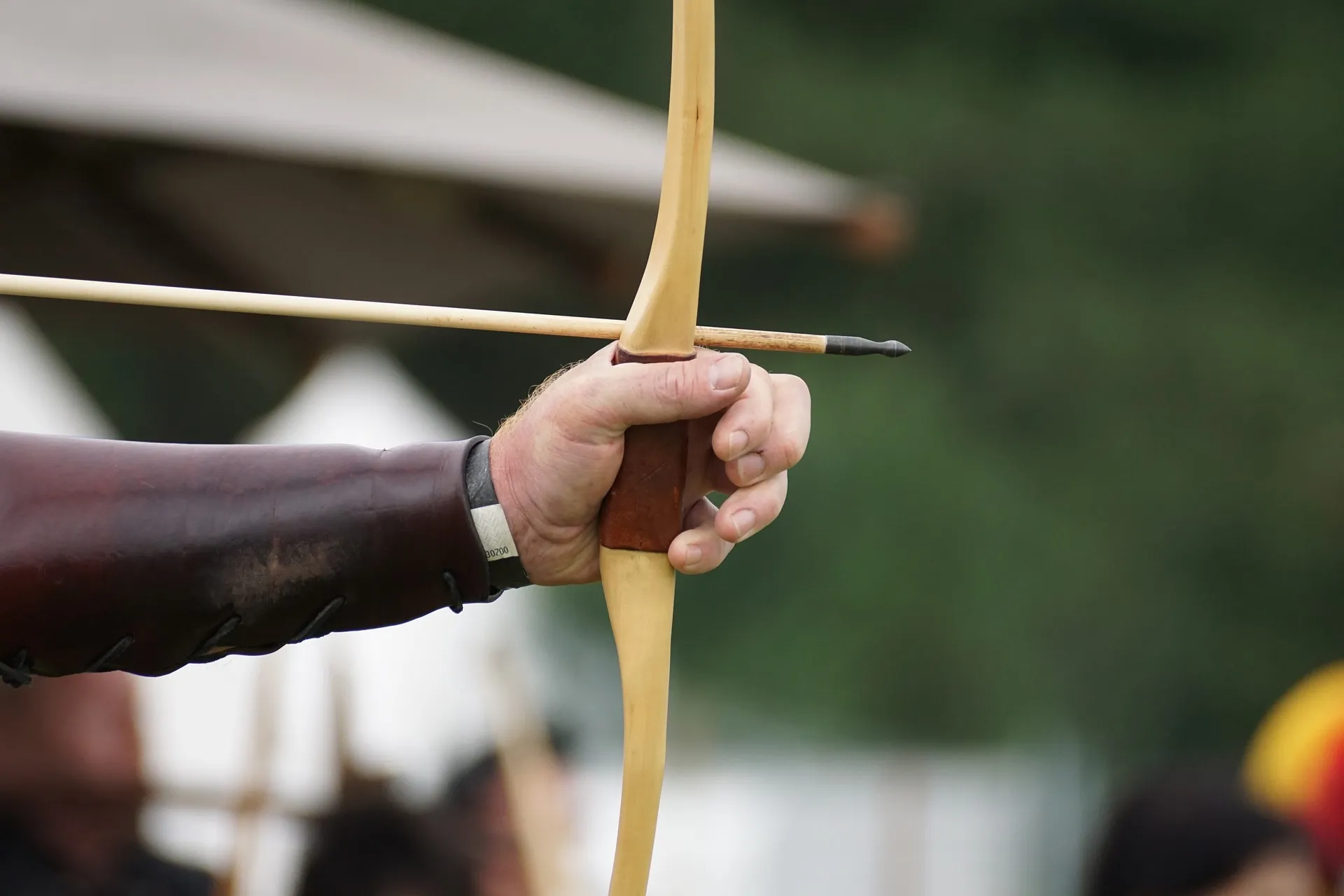
Your bow arm is the foundation of every shot. Point it directly at the target and keep it locked without bending at the elbow.
Any shake or bend in that arm will translate into inches of error at the target, so think of it as a rigid bridge between your shoulder and the bow.
Don’t grip the bow tightly with your fingers. Instead, let the bow rest against the pad of your thumb at roughly a 45-degree angle.
A death grip on the handle torques the bow on release and sends arrows off course. The bow should almost feel like it could fall out of your hand, and many competition archers use wrist slings specifically so they can hold with zero grip pressure.
Make sure your bow arm extends straight out to the side, not angled downward. A common beginner mistake is dropping the arm below shoulder height, which collapses your form and reduces the power transfer from your back muscles into the draw.
Use your back muscles, not your arms, to hold at full draw. If your biceps and forearms are doing the heavy lifting, you’ll fatigue quickly and your groups will open up.
The proper technique engages your rhomboids and trapezius to pull the shoulder blades together while your arms simply maintain position.
The T-draw technique helps build this back engagement. At full draw, your body should form a T-shape: bow arm extended toward the target, drawing arm pulled straight back, shoulders level and square.
If someone looked at you from above, your arms and shoulders would form a straight line.
Draw first, then settle onto your aiming point. Many beginners try to aim while still drawing, which creates a jerky, unstable motion.
A smooth, consistent draw followed by a brief hold on target produces far better results. For more detailed guidance on tightening your groups, check out our archery accuracy tips.
Frequently Asked Questions
An archery butt is a mound or backstop used as a target for archery practice. The term originally referred to the earthen mounds that medieval English archers shot into during mandatory Sunday training sessions. Over time, the word came to describe both the target itself and the field where it was set up.
English kings needed a large supply of skilled archers for their armies. Starting in 1252, laws required men between 15 and 60 to own bows and practice regularly. Designated archery butts were built outside villages to reduce injuries from stray arrows during this compulsory training.
The term isn't commonly used in modern archery, but the concept evolved into today's target ranges. Modern archery uses foam, straw, and layered targets mounted on stands instead of earthen mounds. Competition setups follow World Archery Federation standards with precise distance and target size requirements.
Final Thoughts
Archery butts played an important role in transforming archery from a survival skill into an organized sport with structured training methods. Understanding their history gives you a deeper appreciation for how modern target ranges, scoring systems, and competition formats came to be.
While the earthen mounds and mandatory practice laws are long gone, the core principle behind archery butts remains the same: consistent practice on defined targets is the only path to mastery.